

Skin Cancers
Overview
Managing a skin cancer diagnosis begins with educating yourself about this common form of cancer. Not all skin cancers are alike, so understanding your unique diagnosis is vital. Learn about your type of cancer and the treatment options that are available. But don’t stop there. Discovering how to protect your skin, which is your body’s largest organ and your immune system’s first line of defense against infection and injury, will help you live your best life.
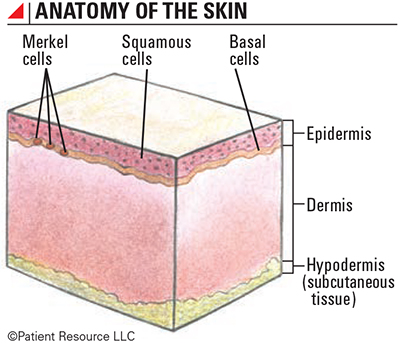
The skin is made up of many layers (see Figure 1). Most skin cancer forms in the epidermis, which is composed of different types of cells. Often, skin cancer begins as precancerous lesions on your skin. Cancerous tumors, lesions and growths frequently appear on the sun-exposed areas of the face, neck, chest, shoulders, arms and back, but they can appear anywhere.
This guide focuses on three types of skin cancer. Cutaneous squamous (pronounced SKWAY-mus) cell carcinoma (cSCC) and basal (BAY-sul) cell carcinoma (BCC) are the most common and are also referred to as non-melanoma skin cancers. Merkel (MER-kul) cell carcinoma (MCC) is a more rare form of skin cancer.
TREATMENT OPTIONS
You will work closely with your medical team to select your treatment plan. It may consist of one or multiple therapies and will be based on many factors, such as the type of skin cancer it is, its size and depth, if it has metastasized (spread) and your previous treatments, if any. Talk with your doctor about the specifics of each therapy before moving forward. Each type of therapy will have side effects, and you want to be informed. Ask questions, and if you don’t understand an answer, ask for a further explanation.
Following are general descriptions of the therapies that might be included in your plan.
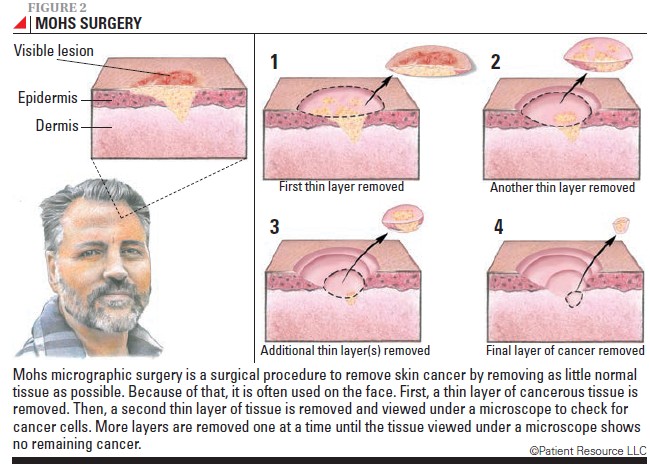
Surgery is often used to remove skin cancer (see Figure 2). It may offer the best chance of controlling the disease and preventing it from spreading, especially for people with early-stage disease. Your doctor may also perform a surgical procedure to stage the cancer. Before surgery, make it a point to talk with your doctor (and potentially, a plastic surgeon) about how your wound will heal and how your scar will look. This can be especially important if you have surgery in an area that is visible to others, such as the head, face and neck areas.
Chemotherapy uses drugs to kill rapidly multiplying cells throughout the body. For skin cancer, it can be applied to the skin as a topical treatment. It stays in that area to treat cancer on the spot. In some instances, chemotherapy may be given by IV in a cycle, typically once every few weeks. It may be used alone or with other drug therapies and forms of treatment.
Immunotherapy drugs stimulate your immune system to find and attack cancer cells. This strategy trains the immune system to respond to cancer, giving it the potential for a response that can extend beyond the end of treatment. It may be given as a shot into a vein in your arm, orally as pills or as a cream that is applied topically. Some immunotherapies are used alone or with other therapies.
Targeted therapy kills cancer cells or stops the progression of disease while avoiding healthy cells. The drugs travel throughout the body via the bloodstream looking for specific proteins and tissue environments to block cancer cell signals and restrict the growth and spread of cancer. Targeted therapy may be given as a shot into a vein in your arm or orally as pills. Some of these drugs may be given alone or in combination with other drug therapies.
Radiation therapy uses high-energy radiation to kill cancer cells. It may be used to treat cancer that is on the skin or that has spread to other parts of the body. Other uses include targeting specific parts of the body for localized disease or bone pain. It may also be delivered to shrink tumors before surgery and/or to kill remaining cancer cells after surgery.
Other treatments. Freezing (cryotherapy), light therapy (photodynamic therapy) and lasers may be used to treat some skin cancers.
Clinical trials offer new drugs, drug combinations, surgeries, medical procedures or devices that are part of research studies looking for new and better cancer treatments. Talk with your doctor as soon as possible after diagnosis to discuss whether a clinical trial may be a good option at any time during your treatment.
