

Skin Cancers
Clinical Trials
Progress in treating all types of cancer, including skin cancer, is a result of clinical trials. In the past decade, therapies tested in clinical trials have significantly improved outcomes for many people who have skin cancer. Although these advances are helping manage and possibly cure the disease, it remains a very common diagnosis. More research, especially in the area of advanced skin cancers, is needed.
Clinical trials are research studies. Most of the advances made in treating cancer today were once therapies or procedures that were developed, tested and evaluated in these studies before being approved by the U.S. Food and Drug Administration (FDA). For skin cancer, treatment trials include surgical procedures, drug therapies and more. However, clinical trials do not focus only on treatment.
Diagnostic tools and procedures, including medical tests, imaging techniques, genetic markers and other methods, are evaluated in clinical trials to assess their accuracy and reliability when being used in patient care. They help determine if a new diagnostic method provides timely and accurate information that may improve patient outcomes.
Disease prevention and patient screening studies examine new and improved methods for identifying a condition earlier or the risk factors for that condition.
Genetic risk factors are studied to help researchers learn more about the genetic disorders and disease-related mutations that cause various types of cancer.
Lifestyle/behavioral changes are explored to measure ways to make people more comfortable as they manage a chronic condition. Some studies test the effect that lifestyle changes have on lowering the risk of cancer and on current cancer treatments.
Recent advances, including immunotherapy, are making significant differences for many people who have skin cancer. However, not everyone responds to the same treatment. More options are needed so treatment plans can be customized to an individual’s diagnosis and unique characteristics.
Currently, a variety of research studies are underway, including, but not limited to, testing specific checkpoint inhibitors alone and with other approaches; immunotherapy as neoadjuvant (before primary treatment) or adjuvant therapy (after primary treatment); therapeutic vaccines; and radiation therapy using alpha-particle technology. Through these innovative studies, researchers are learning more about advanced skin cancers and how they react to certain treatments.
As you consider participating in a clinical trial, know that the medical community relies on volunteers. Being involved may help you now and will definitely help future generations of people with cancer. Also, doctors understand that people can experience the same disease differently because each patient is biologically and genetically unique. For everyone to get the most benefit from cancer research, volunteers of all ages, genders, locations, races and ethnicities, weights, sexual orientations and socioeconomic groups are needed.
The Truth About Clinical Trials
Understanding what clinical trials are – and what they are not – is an important part of selecting your treatment strategy.
True or False? Clinical trials are a last resort.
False! Depending on your diagnosis, a clinical trial may be your best option at any time, even as your first treatment. That is why you should talk with your doctor about clinical trials as soon as possible after diagnosis.
True or False? The risks in a clinical trial intervention make them unsafe.
False! Every type of cancer treatment, also referred to as an intervention, comes with risks. In your Informed Consent document, the potential risks associated with the intervention being used in the trial, as well as much more information about the trial, will be explained to help you make an educated decision about participating.
True or False? I could get a placebo, and my cancer wouldn’t get treated.
False! Even if participants do not get the new treatment being tested in the clinical trial, they still get the standard of care treatment for their diagnosis. Placebos are rarely used in cancer clinical trials.
True or False? Clinical trials are available in big cities and small towns, at major cancer hospitals and small clinics, and even in doctors’ offices.
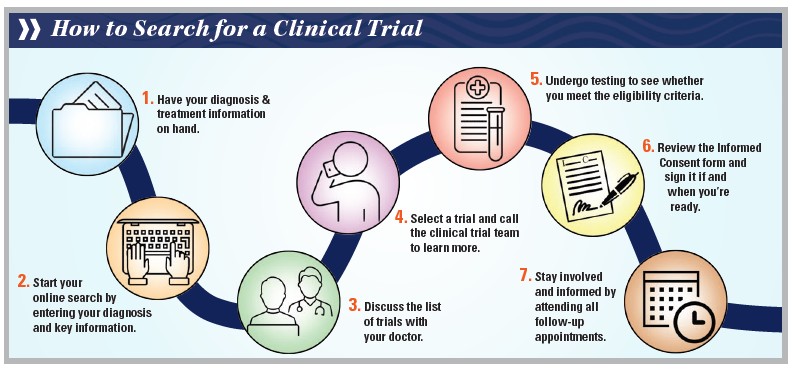
True! As you search for a clinical trial online or with your medical team, make sure to note your location and if or how far you are willing to travel.
True or False? Once I start the trial, I can change my mind.
True! You may leave the trial at any time and for any reason. Talk with your doctor about the standard of care and other treatments that may be available for you.
Clinical Trials Resources
- AIM at Skin Cancer/Carebox Connect: Connect.careboxhealth.com/en-US/partner/aimatskincancer
- ClinicalTrials.gov: www.clinicaltrials.gov
- National Cancer Institute: www.cancer.gov/clinicaltrials, 800-422-6237
- NCI Cancer Information Service: 800-422-6237
