

Skin Cancers
Prevention
Taking action, especially against any form of cancer, is a way to advocate for yourself. Although it isn’t possible to totally eliminate the risk of skin cancer or a recurrence, you can reduce it. Learn what you can do now to protect your skin against ultraviolet (UV) radiation, the primary cause of skin cancer.
Self-Exams
The more familiar you are with your skin, and your body in general, the easier it will be to notice something that doesn’t look or feel right. Start by performing self-exams on your skin (see Figure 1).
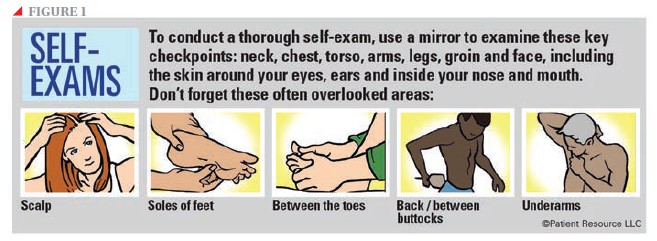
In a well-lit room, simply look over all parts of your body with your own eyes. Use a blow dryer or comb to part your hair so you can see your scalp and a full-length and a handheld mirror. For places that aren’t easy to see on your own, ask a loved one for help. Use your phone to take photos of hard-to-see areas of the body. Reference those photos in the future to see if there have been any changes.
Certain characteristics, such as dark pigment, scars or constantly irritated areas, make it difficult to detect an unusual or changed spot. Tattoos can hide skin problems because the extensive colors or designs make it difficult to notice discoloration or a size change.
Some skin changes are normal, but if you make it a habit of checking your skin regularly, you will notice when something is new, has changed or just doesn’t seem right. When you are concerned, make an appointment between your regularly scheduled visits.
Sunscreen Basics
You must use sunscreen correctly to get the maximum benefit. The two main types are physical and chemical. Both provide effective sun protection, so choosing between them depends on your skin type, preferences and any specific concerns you may have.
Physical (mineral) sunscreens:
- Contain active ingredients like zinc oxide or titanium dioxide
- Create a physical barrier on the skin that reflects and scatters UV rays
- Offer immediate protection upon application, no waiting time needed
- Typically less likely to irritate sensitive skin or cause breakouts
- May leave a white cast, especially on darker skin tones
Chemical sunscreens:
- Contain active ingredients like avobenzone, oxybenzone or octinoxate
- Absorb UV rays and transform them into heat, which is then released from the skin
- Need to be applied 15-30 minutes before sun exposure for full protection
- Typically lighter, more cosmetically elegant on the skin, without leaving a white cast
- Can sometimes irritate sensitive skin, particularly for those prone to acne or allergic reactions
Following are some need-to-know facts:
- Use sunscreen with a sun protection factor (SPF) of at least 30 that says “blocks UVA and UVB” or “broad spectrum” on the label.
- Use sunscreen anytime you plan to be in the sun for more than 15 minutes.
- Use a minimum of 1 ounce (about the same amount as in a shot glass) for your entire body. If you use spray sunscreen, cover all exposed skin. For your face, use a nickel-sized dollop, or two-finger length line of sunscreen.
- Sometimes you can be left with a filmy cast or residue. Look for sunscreen in a tint closest to your skin color. Tinted sunscreen contains ingredients that block visible light and is important for preventing hyperpigmentation and sun-related aging.
- Your ears, scalp, lips, neck, tops of feet and backs of hands need sunscreen.
- Apply underneath your makeup and lip balm, even if they already contain SPF.
- Apply sunscreen first and bug spray second.
- Use sunscreen in all seasons, even when it is cloudy. Snow reflects up to 80 percent of the sun’s rays.
- Check the expiration date on your sunscreen or throw it away 1-2 years after opening.
- Be extra diligent if you are taking medicines that make your skin more sun-sensitive or if you have allergies or skin conditions.
Test Your Knowledge
Q: Is sunscreen necessary if you have a dark complexion?
A: Absolutely! Everyone’s skin is built the same. The top layer of skin, called the epidermis, contains squamous cells, basal cells and melanocytes — and each type of cell can become cancerous.
Q: I’m light-complected. Should I use sunscreen with an SPF of 50?
A: The rule of thumb is to use sunscreen with an SPF of at least 30. SPF 50 is a little stronger, so it’s handy if you burn easily, are at a high altitude or out in intense midday sun. However, both have to be reapplied every two hours when out in the sun (or sooner if you’re swimming or sweating).
Q: Will a ballcap give me all the protection I need?
A: No! It’s great for covering your head but not your ears and neck. A wide-brimmed hat offers better protection. Don’t forget to protect your eyes with UV-blocking sunglasses. Look for clothes and hats that have Ultraviolet Protection Factor (UPF) that provide some protection from the sun.
Q: Are tanning devices safer because they aren’t the actual sun?
A: No! Tanning devices can be even more intense and dangerous than natural sunlight because they emit concentrated UV radiation. Avoiding them is one of the best things you can do to lower your risk.
