

Skin Cancers
Treatment Planning for BCC
Basal cell carcinoma (BCC) is the most common form of skin cancer in the United States. It develops in basal cells, which are round cells in the lower part of the epidermis. BCC has more than 20 subtypes and variants, tends to grow slowly and rarely spreads beyond surrounding tissues.
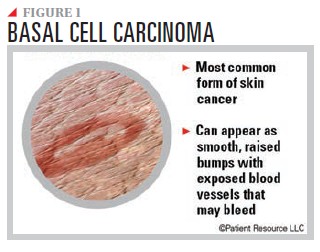
It usually develops on the head, neck or shoulders and can appear as smooth, raised bumps with exposed blood vessels that sometimes bleed (see Figure 1). Various treatment options, used alone or in combination, are available to treat BCC.
Surgery
Cryotherapy, also called cryosurgery, is a treatment that uses an instrument to freeze and destroy abnormal tissue.
Curettage and electrodesiccation removes tissue with a spoon-shaped instrument that has a sharp edge. A needle-shaped electrode is then used to treat the area with an electric current that stops the bleeding and destroys remaining cancer cells around the edge of the wound. It may be repeated to ensure all the cancer has been removed. It is commonly used for BCCs with a low risk of returning.
Shave excision is shaving off the top layers of skin, including the tumor, with a small surgical blade. It is used for small BCCs with a low risk of returning.
Standard excision involves removing the tumor and a margin of normal skin around it. It is commonly used for low-risk BCCs and may be an option for higher-risk BCCs depending on where they are located. It is also used for treating cancer that comes back.
Mohs micrographic surgery may be performed by a specialist when the goal is to save as much healthy skin as possible. Mohs surgery allows the surgeon to examine the margins under a microscope on the same day of surgery to confirm that all the cancer cells have been removed. It is often used when the cancer is on a place on the body that is very visible, such as the face or ears, and has a high risk of returning. The patient is awake during this procedure.
Radiation Therapy
Radiation therapy can be used alone or in combination with other treatments. It is sometimes used as adjuvant therapy after surgery to kill any remaining cancer cells, or if a high risk of recurrence exists. It is also used to treat areas of BCC that are difficult to treat surgically, such as those on the eyelid, nose or ears, or for a very large tumor. It may be a preferable option for people who are not able or do not want to have surgery or who may prefer to manage the BCC instead of remove it. Radiation therapy cannot, however, be used in the same place more than once.
Local and Topical Treatments
BCC tumors that have not grown too deeply into the skin may be treated with local or topical therapies:
- Photodynamic therapy uses a drug and a certain type of light to destroy cancer. A drug is injected into a vein or put on the skin. It accumulates in cancer cells more than in normal cells. Once a laser light is shined onto the skin, the drug becomes active and kills the cancer cells. Photodynamic therapy causes little damage to healthy tissue.
- Topical chemotherapy is applied to skin as a cream or lotion with the goal of killing cancer cells or stopping them from growing.
- Immune response modifiers are a topical immunotherapy that is applied to the skin as a cream. The goal is to recognize the cancer cells as foreign and attack them.
Targeted Therapy
Advanced BCC may be treated with a form of targeted therapy known as a hedgehog pathway inhibitor. It is used to treat locally advanced BCC that has recurred following surgery or for people who are not candidates for surgery or radiation therapy.
The cells in many BCCs have mutations in genes that are part of a cell signaling pathway called hedgehog. The cell signaling pathways are how a cell gives instructions from one part of the cell to another or to other cells. This pathway can be overactive in BCC cells, helping them grow. This form of targeted therapy works by blocking activities in the hedgehog signaling pathway with the goal of slowing its growth. This type of drug is given orally as a pill once daily.
Immunotherapy
Immunotherapy in the form of a PD-1 blocking antibody may be used if targeted therapy drugs are no longer working or if the person is unable to take them. It is a type of monoclonal antibody designed to help the immune system better recognize that cancer cells are foreign to the body. This, in turn, allows the immune cells to better destroy the cancer.
Immune checkpoint inhibitors block the receptors of PD-1 and PD-L1. PD-1 is a protein on the surface of T-cells that helps keep the body’s immune responses in check. PD-L1 is a protein found on some types of cancer cells. When PD-1 attaches to PD-L1, it stops the T-cell from killing the cancer cell. PD-1 and PD-L1 inhibitors keep PD-1 and PD-L1 proteins from attaching to each other, which allows the T-cells to kill cancer cells. Cancer cells may use the PD-1 pathway to hide from T-cells, and that stops the T-cells from attacking cancer cells. It also allows them to grow and spread. These drugs block the PD-1 pathway to help prevent the cancer cells from hiding.
It is given by infusion (IV) every three weeks until disease progresses, the toxicity level becomes unacceptable or up to 24 months.
Clinical Trials
Talk with your doctor early after diagnosis about including a clinical trial in your treatment plan at some point during your care.
Some medications for basal cell carcinoma
- cemiplimab-rwlc (Libtayo)
- imiquimod (Aldara)
- sonidegib (Odomzo)
- vismodegib (Erivedge)
As of 7/11/25
