


Skin Cancers
Treatment planning for MCC
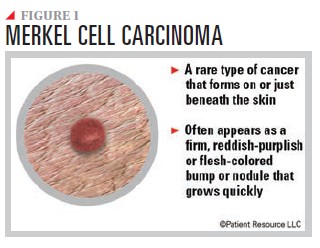
Merkel cell carcinoma (MCC) is a rare form of skin cancer. It grows rapidly, with a high chance for returning and metastasizing (spreading). However, recent advances in MCC treatment are helping people with this diagnosis more effectively manage recurrences.
MCC forms in oval-shaped cells located in the lower part of the epidermis (see Figure 1). It typically appears on sun-exposed skin as a single lump. MCC begins when neuroendocrine cells, thought to be “touch receptors” that help produce the sensation of light touch, become abnormal and grow out of control. It occurs most often in the head and neck area but can also be on the trunk, arms and legs.
It is likely to spread first to nearby lymph nodes and then to distant areas, including skin and lymph nodes elsewhere in the body, as well as to the brain, lungs, bones and other organs.
Many types of treatment are available to treat MCC. Often, more than one type is used.
Surgery
A wide local excision, also called a wide excision, may be used to remove an MCC tumor along with surrounding normal skin and some tissue below the tumor. The edge or border of the tissue removed around the tumor is called the margin. The patient is given local or general anesthesia for this surgery. In some instances, this surgery may be curative.
Mohs micrographic surgery may be performed by a specialist when the goal is to save as much healthy skin as possible. It is often used when the cancer is on a place on the body that is very visible, such as the face or ears. The patient is awake during this procedure.
A lymph node dissection may be done when the cancer has spread to lymph nodes near the primary tumor. All the lymph nodes near the main tumor are typically removed. The patient is given general anesthesia for this surgery.
Sometimes skin grafting and reconstructive surgery are necessary (see Wound Healing, page 15). Talk with your doctor before surgery so you know what to expect.
Radiation Therapy
Radiation therapy may be used in several situations:
- As adjuvant therapy after surgery to kill cancer cells that may still be present.
- If surgery is not an option or not in a place where the entire tumor can be removed.
- As treatment for lymph nodes near the main tumor.
- To treat recurrences after surgery.
- In combination with other treatments if the MCC has spread to distant parts of the body with the goals of shrinking or slowing the growth of the tumor or to easing symptoms.
Typically, radiation therapy is given five days a week for several weeks. Radiation therapy can also be used in shorter dosing regimens if the goal is only to relieve symptoms.
Immunotherapy
Immune checkpoint inhibitors are the form of immunotherapy used to treat MCC. They are a type of monoclonal antibody designed to help the immune system better recognize that cancer cells are foreign to the body. This, in turn, allows the immune cells, called T-cells, to better destroy the cancer.
Immune checkpoint inhibitors block the receptors of PD-1 and PD-L1. PD-1 is a protein on the surface of T-cells that helps keep the body’s immune responses in check. PD-L1 is a protein found on some types of cancer cells. When PD-1 attaches to PD-L1, it stops the T-cell from killing the cancer cell. PD-1 and PD-L1 inhibitors keep PD-1 and PD-L1 proteins from attaching to each other, which allows the T-cells to kill cancer cells.
These immunotherapy drugs may be used after targeted therapy if the drugs are no longer working or if the person is unable to take them. They are typically given as an infusion into a vein, usually every two to six weeks, depending on the specific drug. The goal is to shrink or slow the growth of the tumors.
Chemotherapy
Formerly the main treatment for MCC, chemotherapy is now used if a person is not able to have immunotherapy or has stopped responding to previously used types of chemotherapy. It is most often used in combination with other chemotherapy drugs but may be used alone in certain situations.
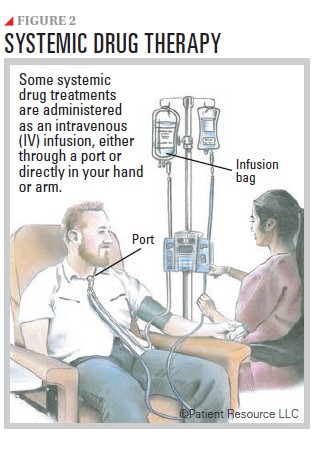
Chemotherapy drugs are typically given into a vein (IV), usually once every few weeks with the goals of shrinking tumors or slowing their growth or relieving symptoms (see Figure 2).
Clinical Trials
Talk with your doctor early on about the possibility of including a clinical trial in your treatment plan. Ask about the types of interventions being tested and when during treatment a trial might be most beneficial.
Some medications for Merkel cell carcinoma
- avelumab (Bavencio)
- pembrolizumab (Keytruda)
- retifanlimab-dlwr (Zynyz)
As of 7/11/25
