

Non-Small Cell Lung Cancer Survivor
Changing the narrative one ribbon at a time
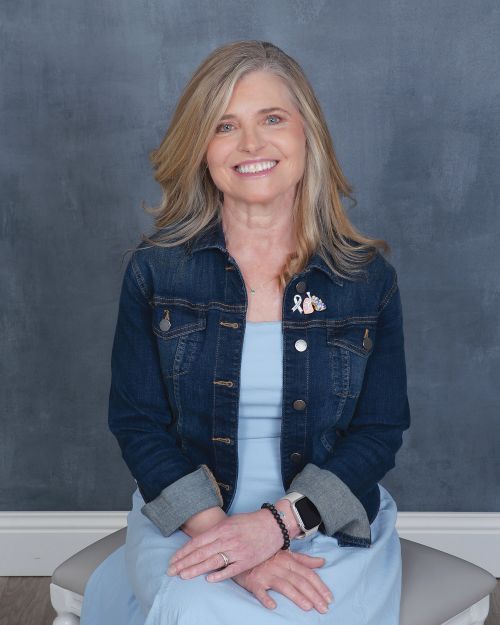
Heidi Onda was 55 when she was diagnosed with Stage IIIA non-small cell lung cancer (NSCLC). She was in excellent health and had no known risk factors. The prognosis was grim until her oncologist suggested a treatment plan with “curative intent.” It fortunately worked as hoped, but Heidi’s story doesn’t end there. She has worked tirelessly to educate others about the need for ongoing comprehensive care post primary treatment.
My lucky charm turned out to be a 6-centimeter ovarian cyst. Though I’d had many cysts in the past, this one was fairly large. My OB/GYN tested for the CA-125 and CEA biomarkers to rule out ovarian cancer. Both were slightly above the normal range. Uncomfortable with those results, he ordered imaging. A mass was discovered under my collarbone. After a biopsy, a pulmonologist called with a Stage IIIA inoperable lung cancer diagnosis. He believed it was terminal and suggested I get my affairs in order.
I dropped the phone, screaming. How was this possible? My husband, Pierre, a primary care physician, and I followed all the rules. We avoided tobacco, didn’t allow junk food in our home and were lifelong health enthusiasts. I was a health educator and fitness trainer. I literally stepped off a stair climber that I’d been on for 50 minutes to take that awful call. My thoughts immediately went to the practical: saying goodbye to my children and teaching Pierre how to pay bills and do all the things necessary to survive this loss.
My life had turned upside down. I felt like I’d lost all control, and we hadn’t even seen an oncologist yet. When we did, we were surprised because he walked in looking pretty chipper. He recommended a treatment plan with “curative intent.” I asked what that meant, and he said, “It means that I hope to get a postcard from you in 10 years from some exotic vacation you’re on.”
That gave me the will to fight. And when he told me he thought I’d do well because I was so healthy and that I may not lose my hair with this chemotherapy, I had hope that cancer treatment wouldn’t be like the images in my head.
My treatment consisted of chemotherapy and radiation therapy, followed by a newly-approved immunotherapy designed to train my immune system to keep fighting. Even though I was terrified, I felt a huge wave of relief because we had a plan. I wanted to know how soon we could start.
Before the radiation began, the radiation oncologist warned us that because we had to target a lymph node wrapped around my aorta, I would be at risk for heart problems down the line. I asked what “down the line” meant, and he said five to ten years. I couldn’t even think that far into the future. After just seven treatments, the tumor was a third of the original size. Even the radiation oncologist was surprised at the progress.
The final part of my treatment was immunotherapy. It was intended to be taken for just one year. The treatment was successful. I wondered if I was lucky or if this was the new frontier of lung cancer treatment. I chose to believe in the new frontier.
That belief is what led me, together with my husband, to start The White Ribbon Project. It began out of my frustration with the lack of lung cancer awareness in the U.S., where the disease was long viewed only as the result of tobacco use. We wanted to change the public perception by showing that anyone with lungs can get it. What started with a few handmade wooden ribbons in our garage has grown into an international grassroots movement that shares stories, reduces stigma, builds community and connects people with larger advocacy organizations that provide free important services for patients and caregivers.
For the next six years, I lived a very full, high-quality life. And then I had a heart attack. Although we can’t be certain that the radiation damaged one of my arteries, it is likely. I realize I was warned about the risk of a heart issue, but it wasn’t a big priority to me at the time.
So, while new treatments are helping people live longer, survivors are now experiencing long-term effects that others before us didn’t live long enough to have. That is why it is vital for patients to advocate for multidisciplinary care throughout treatment and survivorship. Potential long-term effects must be monitored to give us the best chance at survival and quality of life.
I have never regretted having the radiation treatments. Because of them, the tumor shrank to practically nothing, I was able to become a grandmother and we created The White Ribbon Project. I do regret that monitoring for this potential long-term effect was not part of my follow-up plan. It could have delayed or even prevented my heart attack.
Today, my dermatologist monitors me for signs of skin cancer every four months, paying careful attention to my chest. She recently caught and treated a Stage 0 squamous cell carcinoma. My cardiologist is monitoring my heart for radiation-related issues, including damage to my ascending aorta, and is aggressively managing my coronary artery disease. I feel I’ve taken control of my health and encourage others to do the same.
